Hampta Pass
A crossing, not a there-and-back: green Kullu on one side, the bare Lahaul desert on the other, over a 4,287 m pass.
- Days
- 5
- Distance
- 26 km
- Max altitude
- 4,287 m
- Total ascent
- 1,600 m
- Grade
- Moderate
- Season
- Jun–Sep
Elevation profile
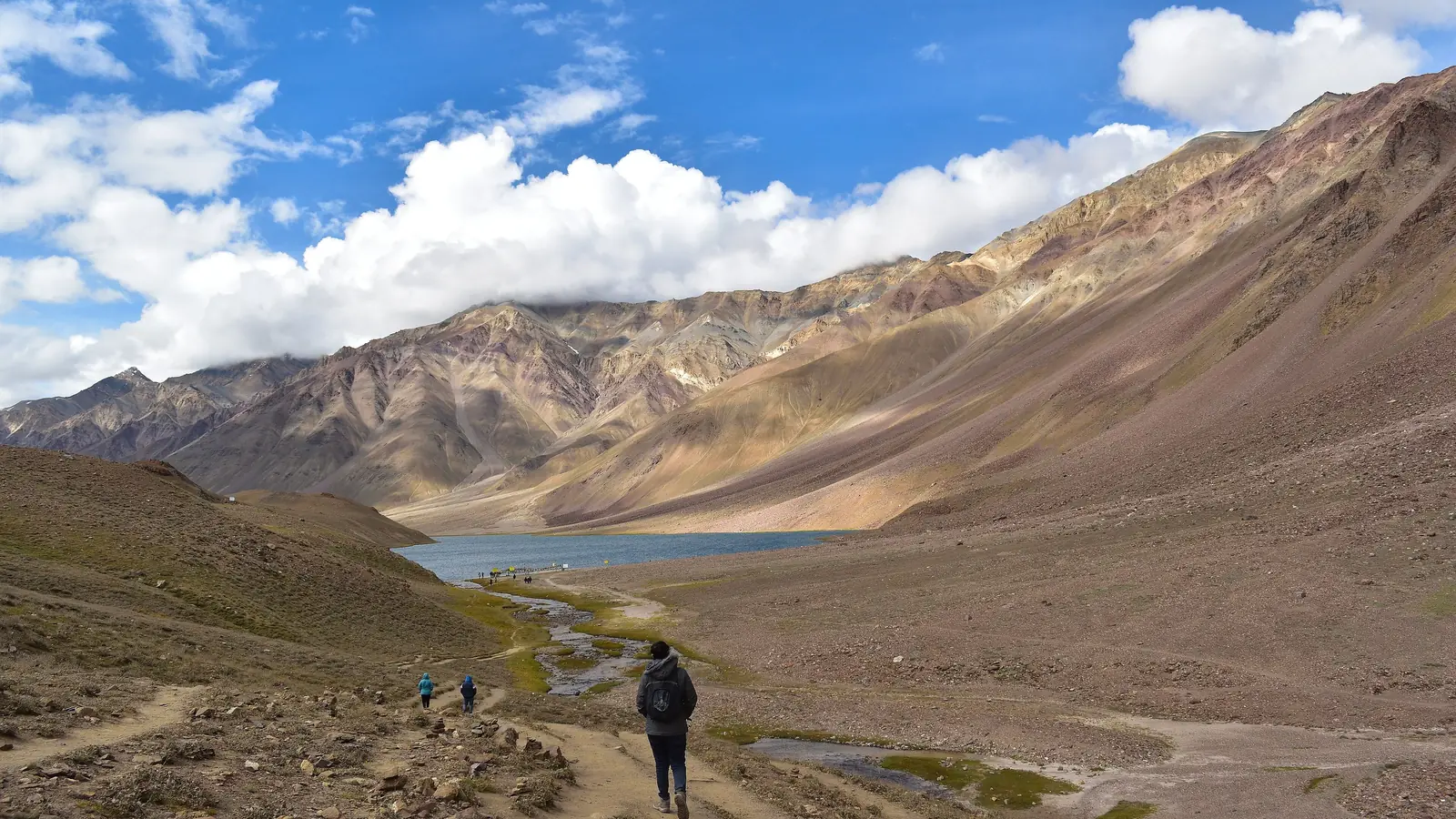
Hampta Pass is the clearest geography lesson in the Indian Himalaya. You start in Kullu, pine forest, wildflower meadows, glacial streams, cross the pass at 4,287 m, and descend into Lahaul, which is arid, brown and looks like a different country. The Pir Panjal wrings the monsoon out of the air, and you walk from one side of that line to the other in a single day.
It runs June to September, which makes it one of the few Himalayan crossings that works during the monsoon, precisely because the far side is in rain shadow. The pass day is the crux: a steep climb to the top and then a sharp, loose descent into the Lahaul valley.
Most operators extend the trip with a road journey to Chandratal, the crescent lake at around 4,300 m. Worth doing if Kunzum La is open, but confirm before you pay: it is a separate permit and a weather-dependent add-on, not part of the walk.
Permits are needed for the trek, obtained from the Forest Department office in Manali. If your itinerary ends at Chandratal you will also need Rohtang and Chandratal permits, which a local operator handles.
Common questions
How difficult is the Hampta Pass trek?
Moderate. Five days, around 26 km, topping out at 4,287 m. The pass-crossing day is long, with a steep climb and a loose descent into Lahaul. Suitable for a fit first-timer, but harder than Kedarkantha.
What permits do you need for Hampta Pass?
A forest entry permit from the Forest Department office in Manali. If your itinerary continues to Chandratal you also need Rohtang Pass and Chandratal permits, a local operator usually arranges all three.
Can you do Hampta Pass during the monsoon?
Yes, and that is its season. It runs June to September because the far side of the pass sits in the Pir Panjal rain shadow, so the Lahaul half stays dry while the rest of Himachal is wet.