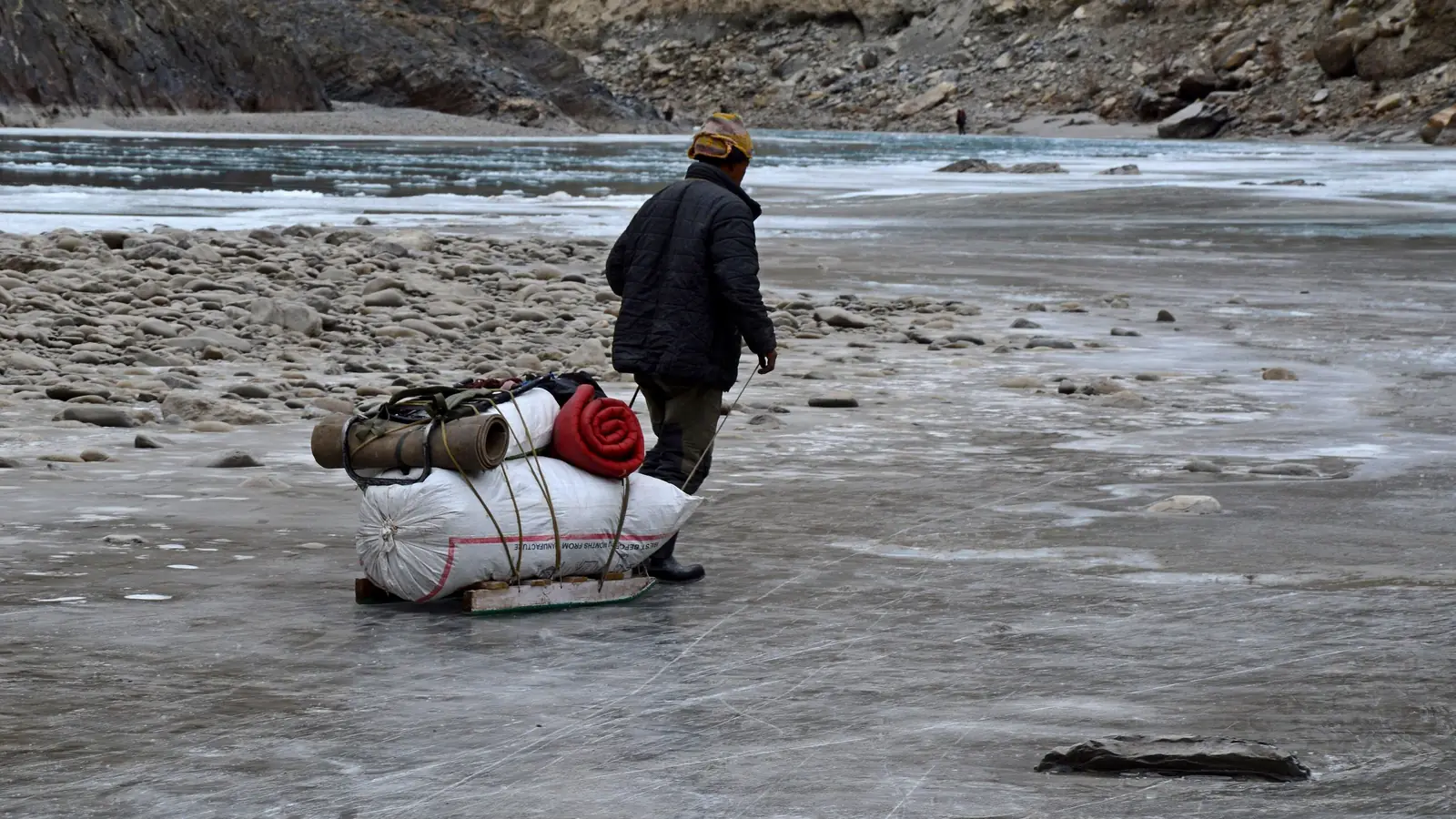
Chadar, the frozen Zanskar
Walking the frozen Zanskar river gorge in deep winter. Almost no ascent, and one of the hardest treks in India, but suspended for the 2026 season.
Not running — season suspended
The 2026 Chadar season was called off by the District Disaster Management Authority in Leh in early January. The Zanskar did not freeze to a safe thickness after an unusually mild winter. No operator can legally run the route this season, if you are offered a 2026 Chadar departure, that is a serious warning sign about the operator. Whether the 2027 season runs will depend entirely on winter conditions and will not be confirmed until around late December.
Last checked 2026-08-06
- Days
- 9
- Distance
- 62 km
- Max altitude
- 3,390 m
- Total ascent
- 620 m
- Grade
- Challenging
- Season
- Jan–Feb
Elevation profile
The Chadar barely climbs, around 620 metres across nine days, and is still one of the most demanding treks in the country. The difficulty is cold, not gradient: −15 °C by day, −25 °C or lower at night, sleeping in tents on ice or in caves.
The ice is never the same twice. Sections that carried you yesterday may be open water today, and the route moves onto the bank and back depending on what the river has done overnight. Reading it is the guide's entire job.
That fragility is now the story. Warmer winters have made the freeze less reliable, and 2026 is the season it failed outright. The route has always been weather-dependent; it is becoming weather-doubtful, and anyone planning around it should treat a confirmed departure as provisional until the ice is actually measured.
When it does run, regulation is strict and worth understanding. The Ladakh Autonomous Hill Development Council requires every trekker to register. You must spend a minimum of two days acclimatising in Leh at roughly 3,500 m and be cleared by a medical officer before you are allowed onto the ice. Permits, wildlife and environmental fees, and mandatory adventure insurance are paid to the Ladakh administration and typically come to around ₹10,000 on top of the trek price.
Common questions
Is the Chadar trek running in 2026?
No. The 2026 season was officially suspended by the District Disaster Management Authority in Leh in early January, because a mild winter left the Zanskar river ice too thin to walk safely. Any operator selling a 2026 Chadar departure is either misinformed or dishonest.
When can you normally do the Chadar trek?
Mid-January to mid-February, when the ice is thickest. The exact window is set by conditions rather than the calendar, and in warm winters it may not open at all, as happened in 2026.
What are the Chadar trek permit and acclimatisation rules?
Every trekker must register with the Ladakh Autonomous Hill Development Council, spend a minimum of two days acclimatising in Leh, and pass a medical fitness check before being cleared onto the ice. Permits, wildlife and environmental fees and mandatory adventure insurance add roughly ₹10,000, paid to the Ladakh administration.
What can you do in Ladakh in winter instead?
Snow leopard tracking in the Hemis high-altitude national park runs through the same window and has become the main winter alternative. Frozen-lake trips to Pangong and monastery festivals at Spituk and Stok also fall in January and February.