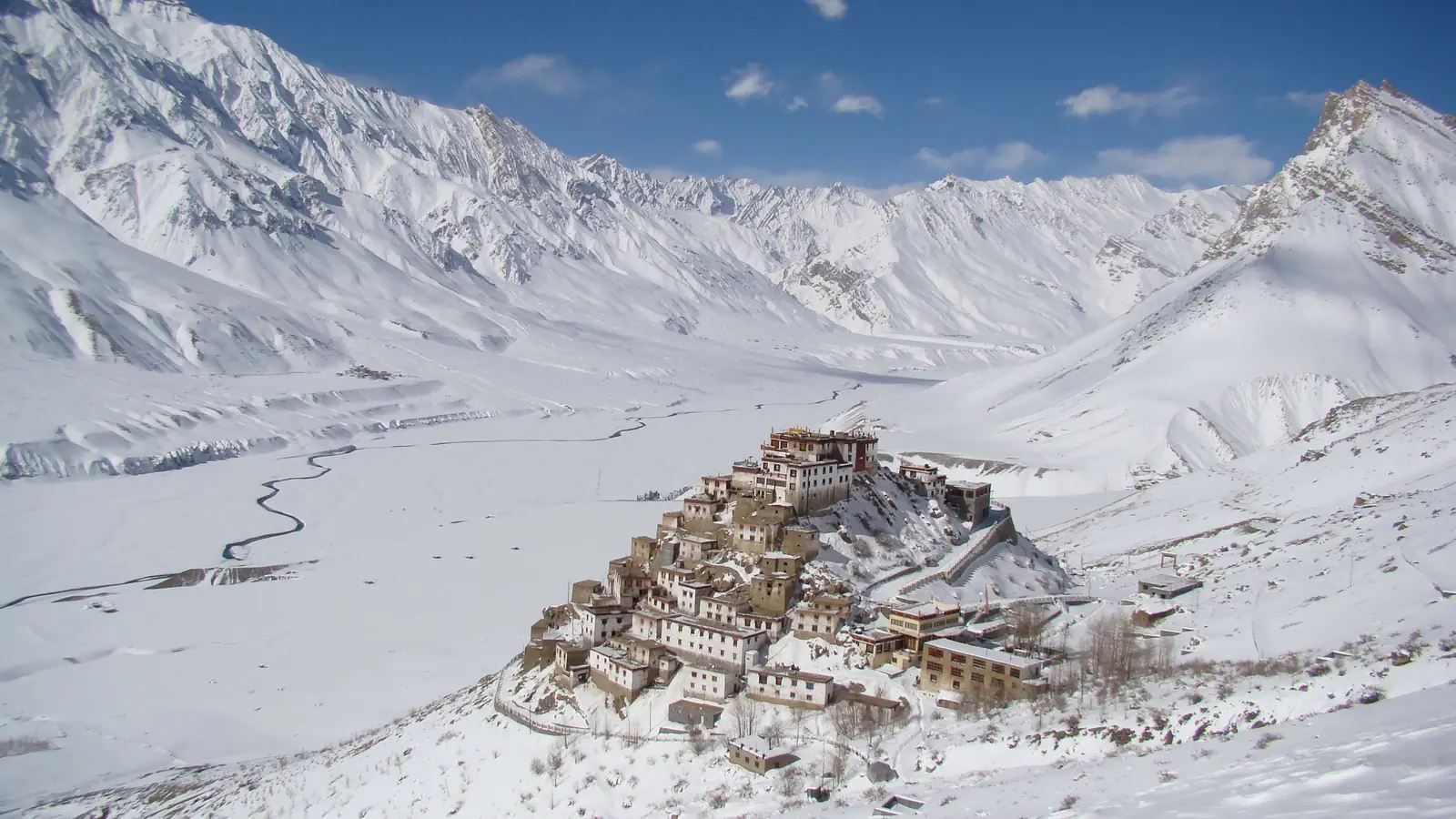
Spiti Valley
Monasteries above the treeline, the world's highest post office, and a road window that shuts by October.
- Altitude
- 3,800 m
- Terrain
- High-altitude cold desert
- Best months
- Jun–Sep
- Region
- Himachal Pradesh, India
Spiti sits in the rain shadow of the Himalaya, which is why it looks nothing like the rest of Himachal. There is almost no rainfall, almost no tree cover, and the valley floor already sits at 3,800 metres, higher than most people have ever slept. The landscape is scree, ochre rock and irrigated barley terraces that turn a startling green in July.
The cultural draw is Tibetan Buddhist. Tabo monastery was founded in 996 CE and holds murals that predate almost everything comparable outside Tibet. Ki Gompa stacks up a hillside above the Spiti river, and Dhankar clings to a spur between two valleys with a lake walk above it at 4,140 metres that doubles as the best acclimatisation day on any Spiti itinerary.
Altitude is the thing most trips get wrong. Coming from Manali you can be sleeping above 4,000 metres within thirty hours of leaving Delhi, which is how people end up with acute mountain sickness on day three. The Shimla approach spreads the gain over four days. Any itinerary worth its price will tell you which route it takes and where the acclimatisation days sit.
Highlights
- Tabo monastery, founded 996 CE, the oldest continuously functioning Buddhist enclave in the Indian Himalaya
- Ki Gompa, the largest monastery in Spiti, at 4,166 m
- Hikkim post office at 4,400 m, the world's highest functioning post office
- Langza fossil fields, marine fossils from the Tethys sea at 4,400 m
- Chandratal lake, reachable only when Kunzum La is open
Common questions
When is the best time to visit Spiti Valley?
June to September for the full circuit, when both the Manali and Shimla roads are open. July and August bring green barley terraces but also landslide risk on the Kinnaur side. Winter Spiti via Shimla is possible from January to March for snow leopard tracking, but Kaza can drop below −20 °C.
Do I need a permit for Spiti Valley?
Indian nationals need no permit for any part of the circuit, just a government photo ID. Foreign nationals need a Protected Area Permit for the Kaza–Tabo–Sumdo stretch, issued same-day at the SDM office in Reckong Peo, Kaza or Shimla with a passport copy and photographs, valid seven days.
How high is Spiti Valley and is altitude sickness a risk?
The valley floor is around 3,800 m and passes reach 4,590 m. Altitude sickness is a real risk, particularly on the Manali approach where the gain is fast. Choose an itinerary with at least one dedicated acclimatisation day and a leader carrying supplementary oxygen.