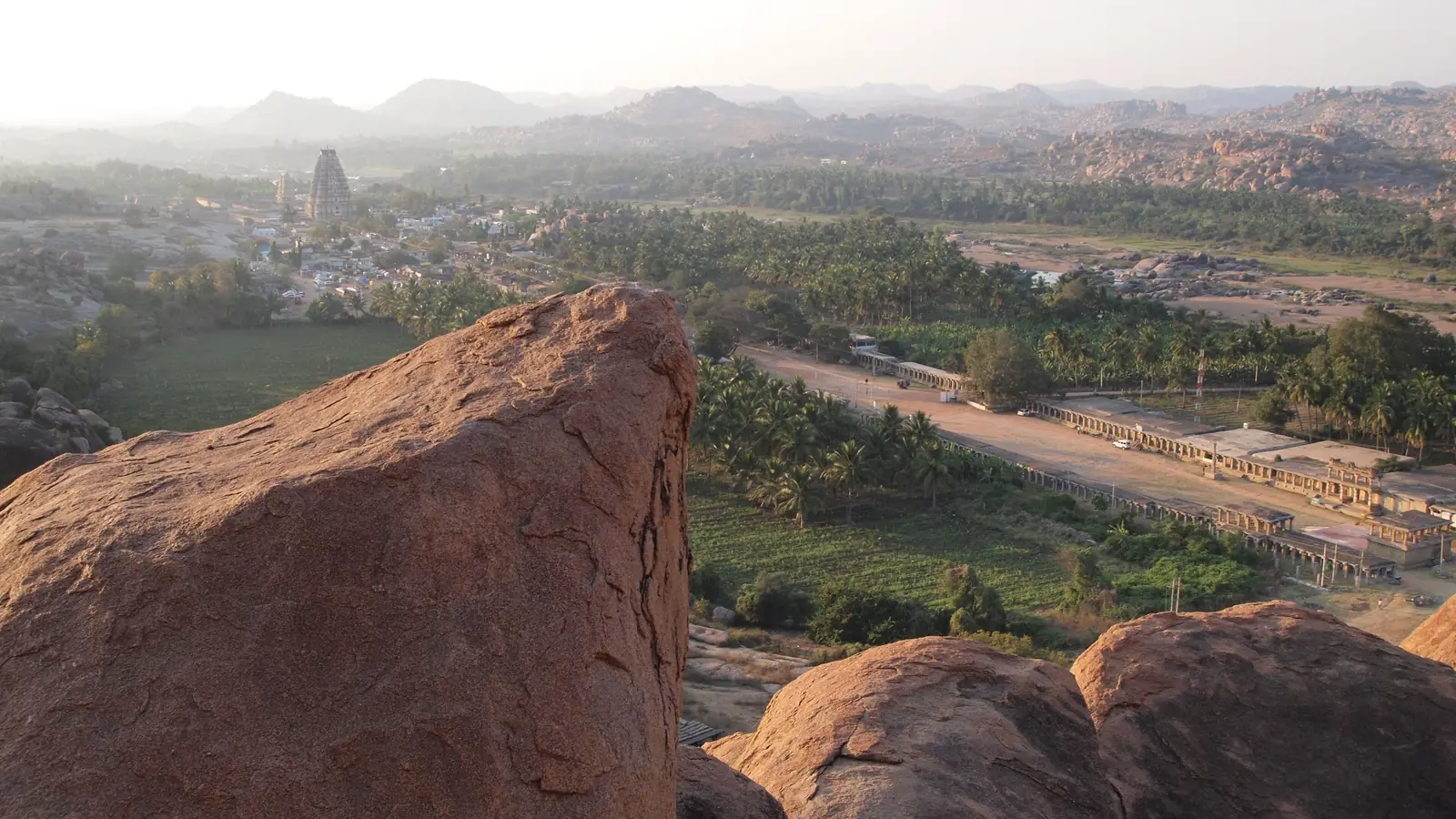
Hampi
Vijayanagara ruins scattered across boulder fields, a UNESCO World Heritage Site and a world-class bouldering ground at once.
- Altitude
- 467 m
- Terrain
- Granite boulder plateau
- Best months
- Nov–Feb
- Region
- Karnataka, India
Hampi was the capital of the Vijayanagara empire and, by several accounts, one of the largest cities in the world in the early sixteenth century before it was sacked in 1565. What survives is spread across roughly 4,100 hectares of granite: temples, aqueducts, market streets, elephant stables and a stone chariot that now appears on the fifty-rupee note.
The Vitthala temple complex holds the musical pillars, slender granite columns that ring at different pitches when struck. They are now roped off to prevent damage, which is why hearing them described by a guide who knows the acoustics matters more than arriving and finding a barrier.
The same boulders that supplied the empire's masons have made Hampi one of the best bouldering destinations in Asia. The climbing season overlaps exactly with the comfortable sightseeing season, and a number of local guides work both.
Highlights
- Vitthala temple complex, stone chariot and the musical pillars
- Virupaksha temple, in continuous worship for over 1,200 years
- Matanga Hill at sunrise, the highest point over the ruins
- Hampi bouldering, hundreds of documented problems on Hampi granite
- Coracle crossing of the Tungabhadra to Anegundi, the older settlement
Common questions
How many days do you need in Hampi?
Two full days covers the main sacred and royal centres at a reasonable pace. Three lets you add Anegundi across the river, sunrise from Matanga Hill, and either bouldering or the Daroji sloth bear sanctuary.
Is Hampi too hot to visit in summer?
From March to June, largely yes. Temperatures regularly exceed 38 °C and the ruins are open granite with almost no shade. November to February is the practical season.
Can you still hear the musical pillars at Vitthala temple?
Not by striking them: they are roped off to prevent further damage after decades of visitors tapping them. Guides can point out which pillars produce which notes and explain the construction that makes it work.