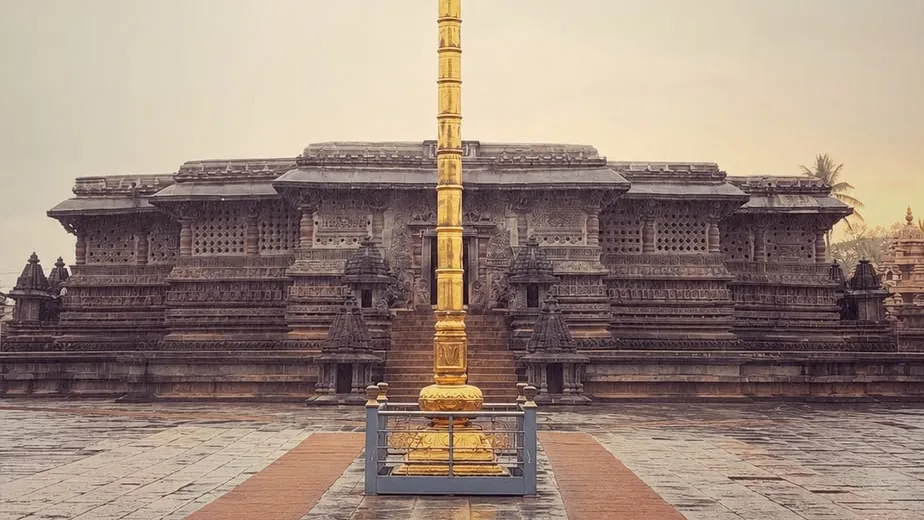
Belur
The Hoysala capital, and a temple begun in 1117 CE that is still in daily worship nine centuries later. Inscribed by UNESCO in 2023 as part of the Sacred Ensembles of the Hoysalas.
- Altitude
- 900 m
- Terrain
- Hoysala temple town on the Yagachi river
- Best months
- Oct–Feb
- Region
- Karnataka, India
The Chennakeshava temple at Belur was commissioned by the Hoysala king Vishnuvardhana in 1117 CE, which makes it a little over nine hundred years old. The main shrine went up in his reign; the wider complex took three generations and something over a century to finish, which is part of why the carving shifts in character as you work around it.
It is cut in chloritic schist, a soapstone soft enough to work like wood when freshly quarried and hardening on exposure to air. That single material fact explains the building: the bracket figures, the jewellery cut free of the stone behind it, the friezes of elephants and horsemen running the full base course. Few other materials in Indian temple architecture allow undercutting of that depth.
UNESCO inscribed it in 2023, together with Halebidu and Somanathapura, as the Sacred Ensembles of the Hoysalas. Belur is the one of the three still in daily worship, and that changes the visit: Halebidu is a monument you look at, Belur is a working Vishnu temple with a monument wrapped around it.
The practical consequence is timing. The grounds stay open through the day but the sanctum closes over the middle of it, usually from about half past one until four, so an early start or a late afternoon is worth planning rather than discovering on arrival. An evening visit works well and the temple is open into it. There is no entry fee.
Highlights
- Chennakeshava temple, begun 1117 CE under Vishnuvardhana
- UNESCO listed in 2023 as part of the Sacred Ensembles of the Hoysalas
- Madanikai bracket figures, undercut almost free of the stone behind them
- Continuous base friezes of elephants, horsemen and narrative panels
- Still an active temple, unlike Halebidu 16 km away
- Free to enter, and open into the evening
Common questions
How old is the Belur temple?
The Chennakeshava temple was commissioned in 1117 CE by the Hoysala king Vishnuvardhana, so it is a little over nine hundred years old. The surrounding complex took considerably longer, three generations and more than a century.
Is Belur a UNESCO World Heritage Site?
Yes, since 2023. It was inscribed together with Halebidu and Somanathapura as the Sacred Ensembles of the Hoysalas, a single listing covering all three temples.
What are the Belur temple timings?
The temple generally opens around 7:30 in the morning and closes at 8 in the evening, with the sanctum shut over the middle of the day, roughly 1:30 to 4:00. It is an active temple, so confirm locally around festivals, when the pattern changes.
Is there an entry fee at Belur?
No. Entry to the Chennakeshava temple is free, which is worth knowing because several protected Hoysala sites do charge. Budget for a guide if you want the carving explained, since that is what the visit turns on.
How far is Belur from Chikkamagaluru?
About 23 km, well under an hour. Belur is in Hassan district rather than Chikkamagaluru, though it is routinely listed as a Chikkamagaluru attraction because of that short drive.
Should you visit Belur and Halebidu together?
Most people do; they are 16 km apart and were built by the same dynasty. They are not the same experience. Belur is a living temple, Halebidu is a monument no longer in worship, and seeing them in that order makes the difference obvious.