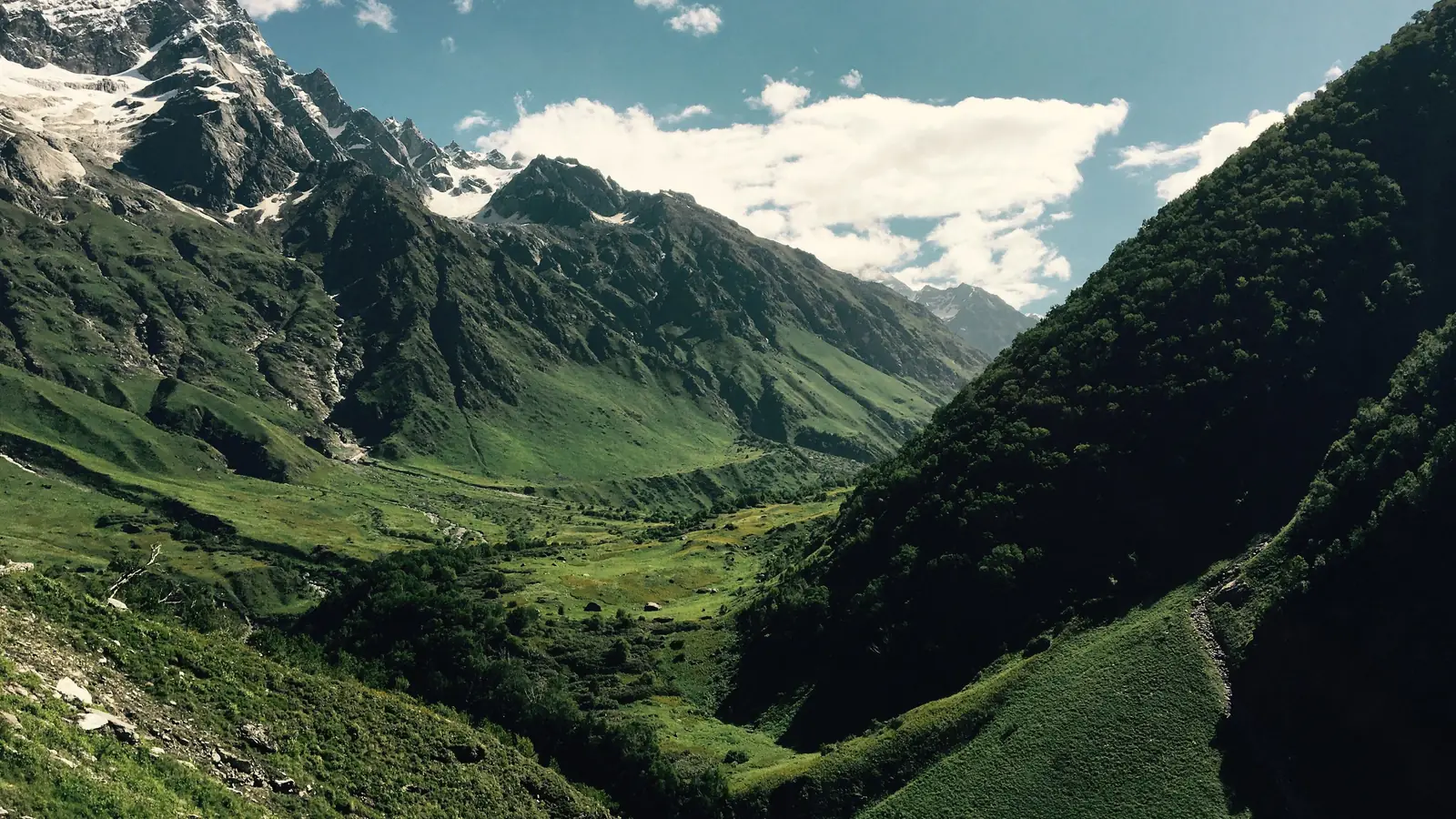
Valley of Flowers
A UNESCO World Heritage valley that blooms only in the monsoon. Roughly 300 flowering species, and a park that opens 1 June and closes in October.
- Days
- 6
- Distance
- 38 km
- Max altitude
- 4,329 m
- Total ascent
- 2,500 m
- Grade
- Moderate
- Season
- Jul–Sep
Elevation profile
The Valley of Flowers is unusual among Indian treks in that its season is the monsoon, not despite it. The rain is what triggers the bloom. Peak flowering runs from mid-July through August, when the valley floor carries brahma kamal, blue poppy, cobra lily and several hundred other species across a two-kilometre-wide bowl at around 3,600 m.
The park opened for the 2026 season on 1 June and stays accessible until October. Entry costs ₹200 for Indian nationals and ₹800 for foreign nationals, valid three days, and permits are issued at the park entrance near Ghangaria or booked in advance through the Uttarakhand forest portal.
Camping inside the valley is not permitted. You stay at Ghangaria and walk in and out each day, which is why the trip is built as a base-camp trek rather than a traverse.
Most itineraries pair the valley with Hemkund Sahib at 4,329 m, a glacial lake and Sikh shrine reached by a steep stone-paved climb from the same base. That is where the real altitude on this trek comes from, and it is a hard day regardless of the paving.
Common questions
When does the Valley of Flowers open in 2026?
The park opened on 1 June 2026 and remains accessible until October. Peak bloom is mid-July through August, earlier and you get a green valley with few flowers, later and the bloom is fading.
What is the Valley of Flowers entry fee?
₹200 for Indian nationals and ₹800 for foreign nationals, each valid for three days. Permits are issued at the park entrance near Ghangaria or booked ahead through the Uttarakhand forest portal.
Can you camp inside the Valley of Flowers?
No. Camping is prohibited inside the national park. Trekkers stay at Ghangaria and walk in and out each day, which is why it is run as a base-camp trip rather than a point-to-point trek.