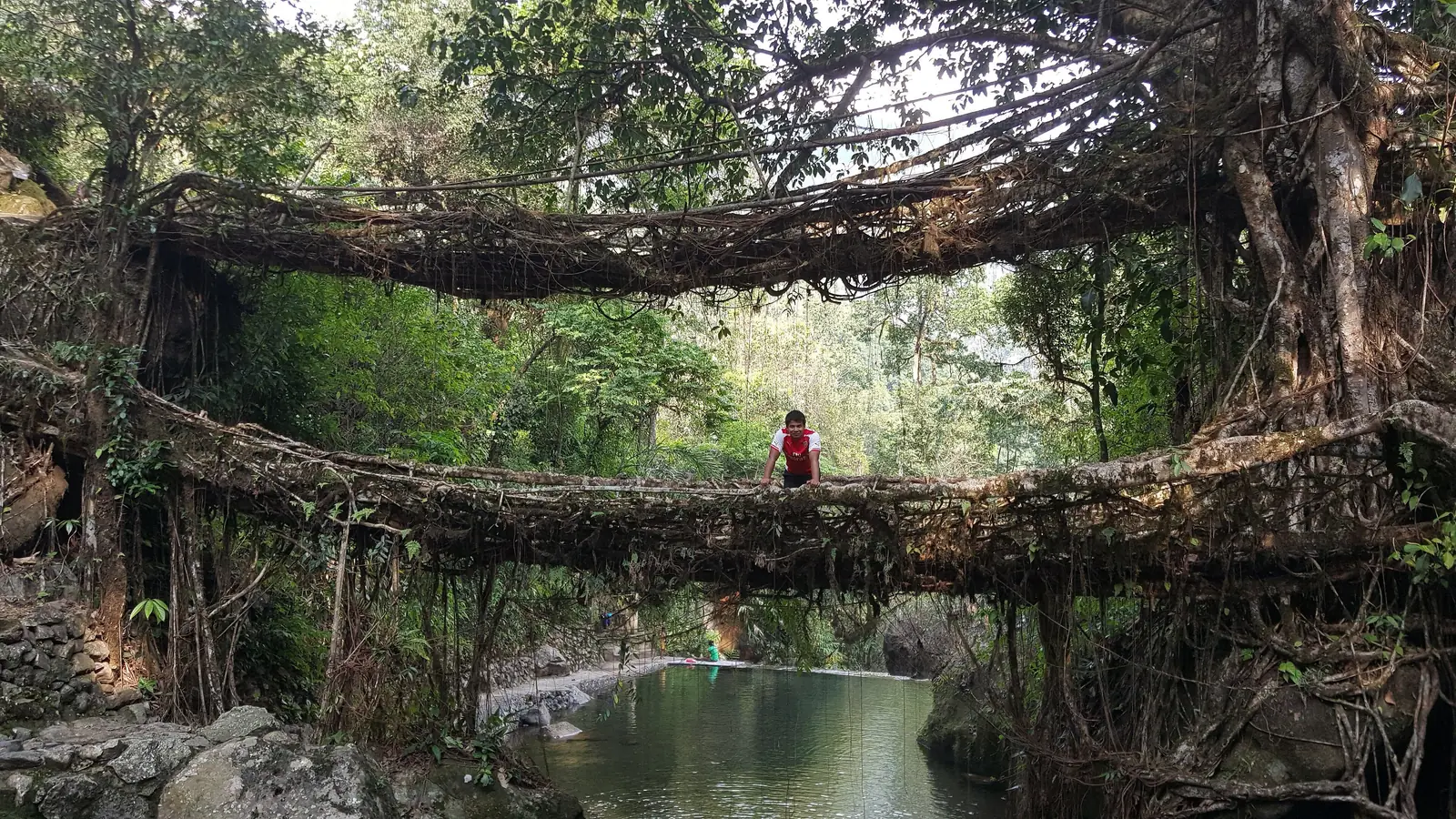
Living Root Bridges
Ficus roots trained across river gorges over sixty years by Khasi families. The wettest place on earth, still growing.
- Altitude
- 1,180 m
- Terrain
- Subtropical rainforest gorge
- Best months
- Oct–Apr
- Region
- Meghalaya, India
A living root bridge is not built; it is grown. Khasi and Jaintia families guide the aerial roots of Ficus elastica across a stream using hollowed betel trunks as scaffolding, then wait. A bridge takes fifteen to thirty years to become load-bearing and keeps strengthening for a century after that. Some in use today were started by people five generations back.
The best known is the double-decker at Nongriat, two spans stacked over the Umshiang stream, reached by roughly 3,000 stone steps down from Tyrna. It is a genuine descent, the return climb in humidity above 90 percent defeats plenty of people who treated it as a photo stop.
Sohra, still widely called Cherrapunji, holds records for the highest rainfall in a year and in a month. That rainfall is precisely what makes the bridges possible and why the region is a maze of gorges, plunge pools and waterfalls that run hard from June and thin out by February.
Highlights
- Umshiang double-decker root bridge at Nongriat, two stacked living spans
- Rainbow Falls, a further hour beyond Nongriat
- Nohkalikai Falls, India's tallest plunge waterfall at 340 m
- Mawlynnong, maintained as one of Asia's cleanest villages
- Arwah and Mawsmai limestone caves with marine fossils
Common questions
How difficult is the trek to the double-decker root bridge?
Around 3,000 steps down from Tyrna and the same back up, typically 5–7 hours round trip. The descent is hard on knees and the return climb is genuinely strenuous in high humidity. Most people are more comfortable staying overnight at Nongriat and splitting it across two days.
When should I visit the living root bridges?
October to April for safe, dry walking. Visit in the monsoon months only with a local guide: the forest is at its most spectacular but stone steps become slick and streams rise fast.
Are the root bridges natural or man-made?
Both. The tree is wild Ficus elastica; the bridge is deliberately trained by Khasi families over 15–30 years and maintained across generations. They are living structures, so they get stronger with age rather than decaying.